

“Our patients’ goals are their own.”
That principle is repeated often among nurses at Prevention Point Philadelphia (PPP), where clinical care is shaped through trust, consistency, and long-term relationships with patients. Rachel Neuschatz, full-time RN at PPP’s Kensington Avenue location, describes how “wound care was often a way that people felt able to transition from using nonclinical services—or nothing at all—to connect to other clinical services like STI and HIV testing, medication for opioid use disorder (MOUD), PrEP, HIV care, and many other things.” That trajectory reflects PPP nurses’ approach to care—one built through respect and thoughtful coordination with other services as they become relevant to the patient.
PPP nursing care began in 2017 through our nurse-led wound care clinic, initially a mobile program serving mostly people using substances and/or experiencing homelessness. The clinic was established years before xylazine and other tranquilizers became widespread in Philadelphia’s street drug supply, and before drug-related wounds became the subject of intense media coverage. By the time public attention turned toward “tranq wounds,” PPP’s nurses had already spent years providing wound care in the community.
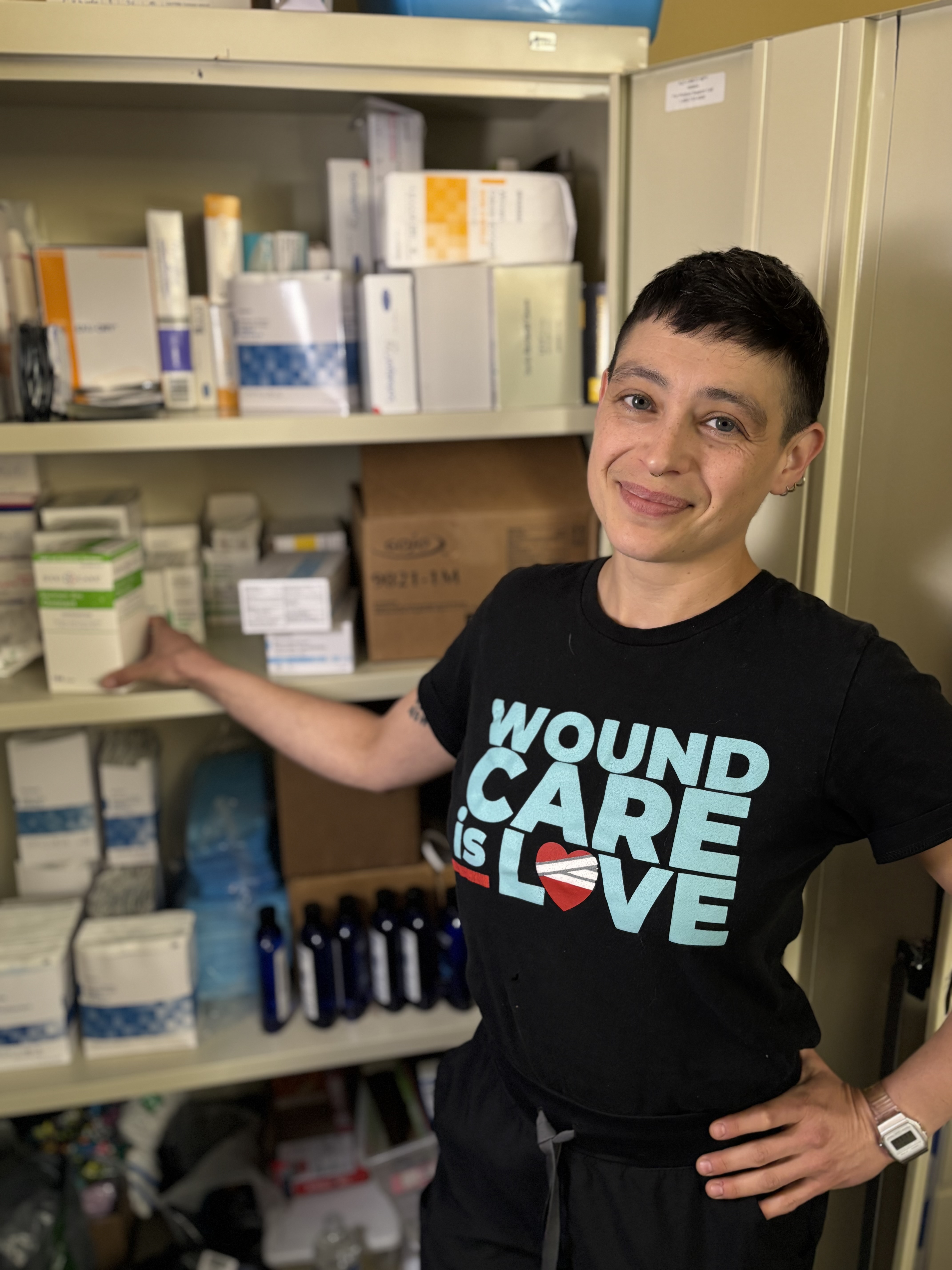
The clinic eventually moved into PPP’s main building, and its approach to care continues to be shaped by changing patient needs and evolving conditions on the streets.
“I think if we would've started in the building without that kind of exposure for all those years, it would've taken a while for us to build up the number of consistent people that we were seeing,” says Kristi Petrillo Straub, Lead Nurse Practitioner and Wound Care Clinic Coordinator.
Rachel notes that “as the years went by and the drug supply changed, then the wounds changed,” and wound care evolved alongside this shifting environment. Still, the clinic continues to treat people with both long-standing chronic conditions from the mobile clinic days and newer acute conditions. Throughout its evolution, patient autonomy has remained central.
“As a nurse, I can be there to assist and provide clinical assessment, feedback, and collaborative discussion of a plan,” Rachel explains. “But if someone's in a lot of pain, has other preferences, or has been assaulted recently—or any other number of reasons for a need to change clinical care based on trauma-informed practices—they would take the lead in their own dressing change.”
That collaborative approach now extends into newer clinical settings at PPP. Medical services at Philly Home at Girard—an emergency shelter operated in partnership with the City of Philadelphia and Project HOME—launched about two years ago. There, dedicated onsite nursing care is available 12 hours a day, from 8 a.m. to 8 p.m., exclusively for residents. The walk-in, multi-service clinic resembles urgent care, says Kelsie Munion, Resident Nurse Supervisor. “People come downstairs from the residential area and they just let the triage desk know what they’re here for. Then we come get them,” she explains.
Because nurses work specifically with Philly Home at Girard residents, patients have consistent access to nursing staff over time. That continuity distinguishes the space from traditional medical settings and supports the development of sustained clinical relationships. As Kelsie explains, “there’s not a time crunch to have to get to the next person and you’re not constantly rushing through appointments... you really do get to take care of the whole person.”
Kelsie describes how patients often arrive for one concern, and “then you start talking to them, and the visit develops into something else,” with care shaped through ongoing interaction. “Since we establish that trust, they might allow us to do a little bit more for them or care for them in a different way that they were not open to the first time,” she says.
Across clinics, nursing at PPP is defined by continuity, patient autonomy, and relationships that strengthen over time.
“They are not just people in active addiction,” Kelsie says of her patients. “These are whole individuals, with a whole lifetime of stories.”
Wound care resources endorsed by PPP nurses:
Xylazine-associated Wounds: Clinical Experience From a Low-barrier Wound Care Clinic in Philadelphia
Prevention Point Philadelphia remembers Stephanie Klipp, RN, CARN, CAAP, who was integral to the founding of medical services at Philly Home at Girard.